
Increasing debt, liquidity problems and mounting creditor claims can threaten the functioning of even prosperous companies. Many entrepreneurs in such a situation face a dilemma: is bankruptcy the only solution?


Arrangement proceedings – how to reach an agreement with creditors and save your company?
5 min.
05 February 2025
Arrangement proceedings – how to reach an agreement with creditors and save your company?
5 min.
05 February 2025
Increasing debt, liquidity problems and mounting creditor claims can threaten the functioning of even prosperous companies. Many entrepreneurs in such a situation face a dilemma: is bankruptcy the only solution?
Arrangement proceedings are an alternative that enables debt restructuring and avoids liquidation of the business. Arrangement proceedings are a procedure provided for in restructuring law, the purpose of which is to conclude an arrangement with creditors and implement arrangement proposals tailored to the debtor’s financial capabilities. In this article, we present the rules of these proceedings and the benefits and challenges associated with their application.
When should arrangement proceedings be considered?
By definition, the purpose of restructuring is to avoid bankruptcy by enabling the debtor to enter into an arrangement with creditors and improve their financial situation. Entrepreneurs should consider using this procedure when the following circumstances arise:
- liquidity problems – inability to settle liabilities on time,
- excessive debt – the value of liabilities exceeds the company’s assets,
- increasing pressure from creditors – debt collection proceedings, threat of bailiff enforcement, termination of credit and leasing agreements,
- temporary operational difficulties – decline in revenue, market changes or unfavourable legal regulations.
An important aspect is the right moment to decide on restructuring. Taking action too late may lead to the inability to implement an effective recovery plan.
The essence of composition proceedings and their application
Arrangement proceedings are one of four restructuring procedures regulated by the Restructuring Law. They enable a company to restructure its debt by entering into an arrangement with its creditors, which allows it to spread its liabilities over time, reduce its debt or change its structure in a way that ensures the company’s continued operation.
The use of this form of restructuring is particularly beneficial for companies that find themselves in a difficult financial situation but still have the potential to continue their operations. Arrangement proceedings are chosen by companies which, due to growing debt and deteriorating financial liquidity, need to renegotiate the terms of repayment of their liabilities. The condition for effective restructuring in this procedure is to reach an agreement with creditors and present realistic arrangement proposals.
The course of the arrangement procedure
Each stage of this process requires careful preparation of documentation and effective communication with creditors, as the final shape of the arrangement depends on their decisions. Below we present a step-by-step guide to this procedure – from the moment the decision to restructure is made to the implementation of the arrangement approved by the court.
Preparation and submission of the application
The first stage is to analyse the company’s financial situation and draw up arrangement proposals, which may include, among other things: reduction of part of the liabilities, spreading the debts into convenient instalments, deferral of payment deadlines or conversion of debt into shares.
An application to open arrangement proceedings should be submitted to the restructuring court competent for the main centre of the entrepreneur’s core business. The application should be accompanied by, among other things, a current list of assets, a list of creditors with the amount of their claims, and preliminary arrangement proposals.
Commencement of proceedings and protection of the debtor
Upon commencement of proceedings, the company gains protection against bailiff enforcement and the possibility of termination of important contracts. Enforcement proceedings concerning claims covered by the arrangement are suspended.
Creditors may not pursue their claims in a manner that interferes with the restructuring process, which allows the entrepreneur to continue their business and prepare for negotiations.
Voting on the arrangement and its approval by the court
During the proceedings, the debtor negotiates the terms of repayment of their liabilities with their creditors. The arrangement is accepted if it is supported by a sufficient majority of creditors, taking into account both the number of votes and the total amount of claims covered by the restructuring. Once the arrangement proposals have been accepted by the creditors, the arrangement is submitted to the court, which assesses its legality and feasibility.
If the court finds that the arrangement meets the formal requirements and can be effectively implemented, it approves it, making it binding on all creditors covered by the proceedings. Otherwise, the proceedings may end in failure, forcing the entrepreneur to consider alternative restructuring scenarios.
Implementation of the arrangement and its effects
Once the arrangement has been approved by the court, the entrepreneur is obliged to implement its provisions in accordance with the agreed schedule. The arrangement becomes binding, which means that creditors can only pursue their claims under the terms specified in its content. Compliance with the terms of the arrangement is supervised by an arrangement supervisor, who monitors its implementation. A breach of the terms of the arrangement may lead to its revocation, which means a return to the original terms of the debt and may result in the need to declare bankruptcy.
Why is it worth seeking professional advice?
Arrangement proceedings are an effective restructuring tool, but their success depends on proper preparation and skilful negotiation with creditors. Experienced advisers can guide the entrepreneur through the entire process, minimising the risk of errors and increasing the chances of the arrangement being approved by the court.
One of the most proven teams in the field of restructuring and arrangement proceedings is RBBC – a law firm that has been helping entrepreneurs regain financial stability and avoid bankruptcy for years. Their experts combine in-depth knowledge of the law with a practical approach to negotiations, effectively representing their clients in dealings with creditors and restructuring courts. If your company is facing financial difficulties, RBBC is a partner you can trust.
Related entries
What about COVID-related restructuring?
On 1 December 2021, an amendment came into force which, with certain changes, permanently implemented the solutions offered by the simplified restructuring procedure.
2 min.
03 February 2022


Accelerated composition proceedings – a lifeline for companies in financial crisis?
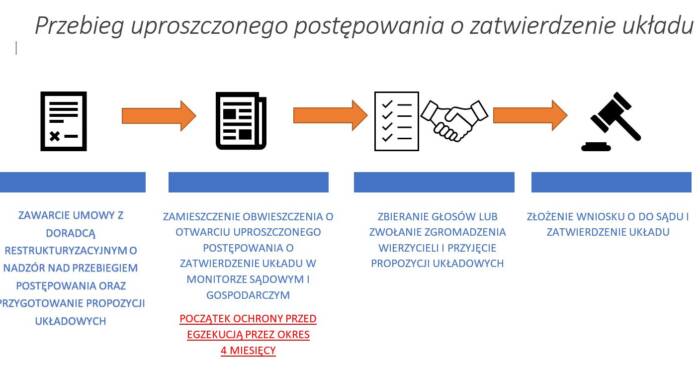
For many entrepreneurs, a financial crisis is a critical moment that requires decisive action. Accelerated composition proceedings (PPU) are a tool that allows companies to quickly reach an agreement with creditors, giving them a chance to regain financial stability.
5 min.
21 January 2025



Suspension of enforcement without court proceedings, i.e. ‘Anti-Crisis Shield 4.0’ and new simplified proceedings for approval of an arrangement
In response to the effects of the epidemic and in order to create another tool to help entrepreneurs, the legislator has introduced a new simplified restructuring procedure based on the existing arrangement approval procedure.
5 min.
19 July 2020
Restructuring adviser – what exactly are their powers?
Restructuring is one of the most important legal tools that the legislator has provided for entrepreneurs in financial difficulties. For this process to be effective, it is necessary to engage a specialist with the appropriate qualifications, experience and statutory powers – a restructuring adviser.
7 min.
23 April 2025


What are the consequences of failing to file for bankruptcy on time? Liability of management board members
The management board of a company that is unable to meet its liabilities cannot afford to remain inactive. The law clearly specifies when a bankruptcy petition must be filed – and what the consequences are for failing to comply with this obligation.
6 min.
10 May 2025


How to effectively prepare a company for restructuring?
Company restructuring sounds like a challenge that only affects those who find themselves in crisis. But the truth is that every organisation, regardless of its current situation, may one day face the need to take corrective action.
10 min.
29 November 2024



Arrangement proceedings or rehabilitation proceedings – which restructuring solution should you choose?
The restructuring process is an important tool for companies that find themselves in financial difficulties. In Poland, the law provides for several forms of restructuring proceedings, including rehabilitation proceedings and composition proceedings.
5 min.
26 March 2025


Changes to restructuring law in 2025
On 25 July 2025, the Sejm of the Republic of Poland passed an act amending the Restructuring Law, the Bankruptcy Law and the National Debt Register Act. On 5 August this year, the amendment was signed by the President of the Republic of Poland and will become binding law 14 days after its publication in the Journal of Laws.
1 min.
05 August 2025