
Company restructuring sounds like a challenge that only affects those who find themselves in crisis. But the truth is that every organisation, regardless of its current situation, may one day face the need to take corrective action.


How to effectively prepare a company for restructuring?
10 min.
29 November 2024
How to effectively prepare a company for restructuring?
10 min.
29 November 2024
Company restructuring sounds like a challenge that only affects those who find themselves in crisis. But the truth is that every organisation, regardless of its current situation, may one day face the need to take corrective action.
Even if your company is running smoothly today, it is worth knowing what the restructuring process involves and how to prepare for it properly. After all, it is better to be proactive than to face the consequences of negligence.
Why is it worth preparing for restructuring in advance?
Preparation is half the battle, and in the case of restructuring, it is the foundation. Planning and taking action in advance gives your company the time and space to make the best decisions. Here’s why it’s worth preparing in advance:
- Better control over the process – you have the opportunity to manage activities yourself in advance, instead of reacting to crisis situations. You decide the pace and direction of change.
- Greater chance of success – companies that begin restructuring when they still have the resources and time to act achieve better results. You can focus on realistic planning instead of acting under pressure.
- Limited damage to your image – well-thought-out restructuring helps you avoid the chaos that often negatively affects relationships with employees, customers and business partners.
- Prevention of problems escalating – early identification of difficulties helps you avoid more serious consequences, such as insolvency or the loss of important company resources.
- Better relations with creditors – entering into discussions with creditors while the company’s situation is still under control gives you more room for manoeuvre in negotiations.
Early preparation allows you to act in advance instead of reacting in crisis mode. This gives the company a better chance of stability and rebuilding trust among stakeholders.
How to diagnose financial problems in a company?
Identifying financial problems is an important step in ensuring the stability of the company and preparing it for the future. Even if the business is running smoothly, regular financial analysis is an invaluable tool that allows you to spot potential threats early on and avoid difficult situations. What is the best approach to this process?
The first step is to thoroughly review the financial documentation. Analysis of the balance sheet, profit and loss account and cash flow provides information about the condition of the company. It is worth paying attention to areas where costs are growing faster than revenues or where losses are occurring.
The next step is to identify areas that are generating losses. Is it a specific product, department or process that is consuming more resources than it is generating benefits? Precisely identifying these areas allows for better planning of changes.
The assessment of financial liquidity should not be overlooked either. A company’s ability to meet its current obligations is an important indicator of its financial health. If liquidity is at risk, swift action may be necessary to secure additional funds or renegotiate the terms of debt repayment.
Preparing a restructuring plan – where to start?
Every successful restructuring is based on a solid plan. When creating it, it is worth considering several elements:
- Cost reduction – identify areas where expenses can be reduced without harming the company’s operations. This may include renegotiating contracts with suppliers, optimising employment or discontinuing unprofitable activities.
- Negotiations with creditors – prepare for talks with banks, contractors, and suppliers. Set priorities for the repayment of liabilities and present realistic proposals for changes in payment schedules.
- Optimisation of operational processes – examine which processes can be simplified or automated. The introduction of modern technologies can significantly reduce costs and increase efficiency.
- Setting strategic priorities – focus on activities with the highest profit potential. It is often better to give up part of the business that generates disproportionate costs.
Every restructuring plan requires clear priorities and consistent action. A well-thought-out schedule allows the company to better manage its resources and focus on areas that are important for its future.
How to prepare the team for the restructuring process?
Employees are the heart of any organisation, so it is important to prepare them properly for change. First and foremost, open communication is essential. Employees need to know why the company is making difficult decisions and what changes are planned. A lack of clear information causes unnecessary stress and gives rise to rumours that can harm the process.
Emotional support for the team is equally important. Restructuring raises concerns, so it is worth organising meetings, training sessions or workshops to help employees understand the new reality. Managers should be available, open to questions and ready for discussions that will dispel doubts. Involving the team in the change process, e.g. through consultations or inviting them to work out solutions together, can also increase their sense of influence and motivation.
Choosing advisors and legal support – is it worth seeking expert help?
Company restructuring is a process that requires not only knowledge of law, finance and management, but also a strategic perspective. Cooperation with experts can be crucial to success. Restructuring advisers help to analyse the situation and develop an effective action plan. They ensure that all steps are in line with applicable regulations. They also identify areas where costs can be optimised and financial liquidity improved.
External support also provides an objective view of the company’s situation. Experts, drawing on their experience gained in other projects, can identify solutions that are overlooked in day-to-day management. In difficult times, their knowledge and perspective can be an invaluable tool for any company.
How to avoid mistakes when preparing for restructuring?
Mistakes can ruin even the best-planned restructuring. To avoid them, it is worth remembering a few rules:
- Do not underestimate the costs of restructuring – this process often requires financial outlays, e.g. for consultants, training or modernisation.
- Avoid not having a contingency plan – it is always a good idea to have an alternative in case the primary plan fails.
- Ensure transparency – a lack of open communication with the team and stakeholders can result in a loss of trust.
Paying attention to every detail of the preparations helps to avoid difficulties that could jeopardise the success of the entire process. With the right approach, restructuring can be the beginning of a new chapter for the company.
Prepare your company for a new start – what steps are worth taking today?
Restructuring is not only the end of problems, but also the beginning of a new stage in the life of a company. It is worth investing in the development of important areas of activity, introducing technological innovations and ensuring a good atmosphere within the team. If you want your company not only to survive difficult times, but also to grow in the future, trust the experts at RBBC. Working with our team gives you the opportunity to develop a strategy that takes into account the specifics of your business and allows you to achieve your long-term goals.
The role of the receiver in bankruptcy proceedings – what is worth knowing?
For many entrepreneurs, the bankruptcy process is a subject shrouded in mystery and, at the same time, a source of concern. When a company is faced with financial difficulties, it becomes necessary to take steps that may seem overwhelming. At this stage, one of the most important participants in the process is the receiver – an entity whose task is to bring order to a difficult situation by balancing the interests of the debtor and creditors. But who exactly is a receiver? What are their responsibilities, and where do their powers end? In this article, we explain what a receiver’s job entails, what role they play in bankruptcy proceedings, and how to choose the best specialist.
Who is a receiver and what are their main responsibilities?
A receiver is an entity whose task is to supervise and conduct bankruptcy proceedings in accordance with the law. They do not act on behalf of the debtor or creditors – their role is to neutrally manage the bankruptcy estate, i.e. the debtor’s assets intended for the repayment of liabilities.
In practice, this means that the trustee:
- takes control of the assets of the company or person declaring bankruptcy,
- is responsible for their valuation and sale,
- coordinates activities aimed at satisfying creditors,
- supervises documentation and ensures the transparency of the process.
However, their role is not limited to formal matters. The trustee often acts as a mediator, helping both parties to understand their rights and obligations. This allows the proceedings to run more smoothly and any disputes to be resolved more quickly.
How does the receiver support the asset liquidation process?
When we talk about asset liquidation in bankruptcy proceedings, the effectiveness and transparency of actions play an important role. The receiver not only assesses the value of the debtor’s assets, but also ensures that their sale is conducted in a manner that is most beneficial to the creditors.
The first step is to value the assets – from real estate and machinery to property rights. The receiver then organises their sale, often in the form of tenders or auctions. This makes the process open and gives the opportunity to obtain the highest possible price.
The funds collected in this way are distributed to creditors in accordance with the order specified by law. The entire process is carried out under strict supervision.
The receiver and the bankrupt – what is their relationship?
Cooperation and understanding of each other’s roles are of great importance in the relationship between the trustee and the bankrupt. By declaring bankruptcy, the bankrupt transfers control of their assets to the trustee, but remains an important participant in the process.
The trustee expects the bankrupt to provide the necessary documents, such as accounting books or contracts, and information about their assets and liabilities. In return, the bankrupt party has the right to be informed about the course of the proceedings and to participate in decisions concerning their assets. Cooperation between these parties is particularly important because a lack of involvement on the part of the bankrupt party may slow down the entire process and negatively affect the outcome of the proceedings.
What rights does the trustee have in bankruptcy proceedings?
The trustee has broad powers that allow him to conduct bankruptcy proceedings effectively. He may manage the debtor’s assets, control financial documentation and make decisions regarding the sale of assets.
It is these powers that enable the trustee to act efficiently and effectively, minimising the risk of disputes and irregularities. However, his powers are strictly defined by law, which prevents potential abuse.
What can a trustee not do during proceedings?
Despite their broad powers, the actions of trustees are subject to certain restrictions resulting from legal provisions and professional ethics. They must adhere to clear rules that define what they are not allowed to do during proceedings. They may not:
- use the bankruptcy estate’s assets for their own needs,
- sell assets without observing the principles of transparency,
- take actions requiring court approval without obtaining it,
- violate the law, including the Bankruptcy Law,
- conceal information from the court or participants in the proceedings.
These restrictions are necessary to ensure the fairness and compliance of the process with applicable regulations. Thanks to them, the trustee performs their function in a reliable and responsible manner.
The trustee as a key player in the bankruptcy process – how can they help?
The trustee is not only the entity managing the bankruptcy estate, but also a person who can help find optimal solutions in difficult situations. Thanks to their knowledge and experience, the bankruptcy process becomes more predictable and transparent. At RBBC, we understand how demanding the bankruptcy period can be, which is why we offer professional support at every stage of the bankruptcy proceedings. If you would like to better understand how our restructuring advisors can support your company in this process, please contact us. Together, we will find the best solution for your company.
Related entries
Reorganisation proceedings – what do you need to know to successfully restructure your company?
Reorganisation proceedings are one of the most effective restructuring tools, allowing entrepreneurs to protect themselves from creditors and implement corrective measures. Thanks to this, a company can avoid bankruptcy and gain time to implement a strategy to improve its financial situation. What does this process look like and how can you increase its chances of success?
4 min.
11 February 2025



Restructuring adviser – what exactly are their powers?
Restructuring is one of the most important legal tools that the legislator has provided for entrepreneurs in financial difficulties. For this process to be effective, it is necessary to engage a specialist with the appropriate qualifications, experience and statutory powers – a restructuring adviser.
7 min.
23 April 2025


Bankruptcies and Restructuring – summary of the first quarter of 2020.
Data on insolvency and restructuring from the first quarter of 2020 compared to the same period last year show a stabilisation in the number of restructuring proceedings and a slight increase in the number of insolvency proceedings, both among companies and consumers.
2 min.
22 April 2020


Arrangement proceedings – how to reach an agreement with creditors and save your company?
Increasing debt, liquidity problems and mounting creditor claims can threaten the functioning of even prosperous companies. Many entrepreneurs in such a situation face a dilemma: is bankruptcy the only solution?
5 min.
05 February 2025


What about COVID-related restructuring?
On 1 December 2021, an amendment came into force which, with certain changes, permanently implemented the solutions offered by the simplified restructuring procedure.
2 min.
03 February 2022


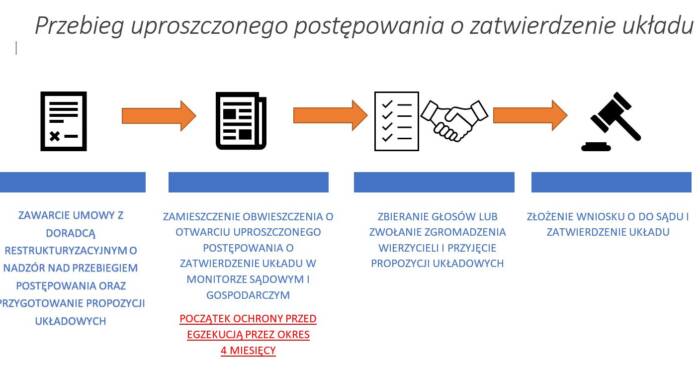
Suspension of enforcement without court proceedings, i.e. ‘Anti-Crisis Shield 4.0’ and new simplified proceedings for approval of an arrangement
In response to the effects of the epidemic and in order to create another tool to help entrepreneurs, the legislator has introduced a new simplified restructuring procedure based on the existing arrangement approval procedure.
5 min.
19 July 2020
Arrangement proceedings or rehabilitation proceedings – which restructuring solution should you choose?
The restructuring process is an important tool for companies that find themselves in financial difficulties. In Poland, the law provides for several forms of restructuring proceedings, including rehabilitation proceedings and composition proceedings.
5 min.
26 March 2025


Changes to restructuring law in 2025
On 25 July 2025, the Sejm of the Republic of Poland adopted an Act amending the Restructuring Law, the Bankruptcy Law, and the Act on the National Register of Debtors. On 5 August 2025, the amendment was signed by the President of the Republic of Poland and—after the lapse of 14 days from its publication in the Journal of Laws—will enter into force as binding law.
2 min.
05 August 2025