When a company faces financial difficulties, restructuring is often the last chance to avoid bankruptcy. Companies that identify financial problems early on can implement corrective measures, protecting themselves from complete operational and legal collapse.


How does company restructuring protect against bankruptcy?
7 min.
13 October 2024
How does company restructuring protect against bankruptcy?
7 min.
13 October 2024
When a company faces financial difficulties, restructuring is often the last chance to avoid bankruptcy. Companies that identify financial problems early on can implement corrective measures, protecting themselves from complete operational and legal collapse.
But what exactly is restructuring? What are its stages and benefits? What signs should cause concern for business owners? We will try to answer these questions by analysing the restructuring process in detail.
What is company restructuring and what are its benefits?
Company restructuring is a process in which a company reorganises its operations to improve its operational, financial and organisational performance. The aim of restructuring is to introduce changes that will help the company survive financial difficulties and regain stability. In practice, this means introducing corrective measures, which may include cost reduction, process optimisation or renegotiation of debt repayment terms.
How does restructuring help prevent bankruptcy?
When a company finds itself in a difficult financial situation, there is a need to take action to protect it from having to declare bankruptcy. Restructuring proceedings give the company the opportunity to manage its debt in a way that allows it to avoid bankruptcy. Thanks to restructuring, the company has a chance to reorganise its operations, which allows it to improve its financial liquidity.
As part of the restructuring, the company can negotiate new debt repayment terms with its creditors, which usually leads to longer payment terms or lower liabilities. This gives the company time to implement corrective measures and streamline its operations. Protection from enforcement actions by creditors gives the company the time it needs to implement its restructuring plan.
Early signs of financial difficulties – when is it worth considering restructuring?
Before a company decides to undergo a restructuring process, it should carefully observe signs that may indicate impending financial problems. A decline in revenue coupled with an increase in operating costs is one of the first warning signs. If a company begins to have difficulties maintaining financial liquidity, which manifests itself in delays in payments to suppliers, employees or financial institutions, it is a sign that the situation requires immediate action.
In addition, growing debt and an inability to repay it on time are further signs that may indicate an impending crisis. At such times, a company should consider restructuring in order to avoid exacerbating its financial problems.
Types of restructuring proceedings in Polish law
Polish law provides for several different types of restructuring proceedings that enable companies to effectively protect themselves against bankruptcy. The choice of the appropriate proceedings depends on the scale of the financial difficulties and the structure of the company’s liabilities. Below we present the most important ones:
Proceedings for the approval of an arrangement
This is the simplest and least formalised restructuring procedure. With the support of the arrangement supervisor, the entrepreneur negotiates the terms of the arrangement with the creditors, and then the court approves the agreement. Creditors play an important role in this procedure, as they must agree to the terms of the arrangement. The advantages of this form are primarily its speed and minimal court intervention.
Accelerated arrangement proceedings
Accelerated arrangement proceedings are a procedure that involves a simplified mode of negotiation with creditors and faster action than in standard arrangement proceedings. This is a good choice for companies that have a less complex structure of liabilities and can quickly reach agreements with most creditors. In these proceedings, the court plays a greater role than in proceedings for the approval of an arrangement, but the process is still more time-efficient. The main advantage is that the company can implement its restructuring plan more quickly and return to normal operations.
Arrangement proceedings
These are more formal proceedings in which the court and the court supervisor play an important role. Arrangement proceedings are aimed at companies with a more complex financial structure or with multiple creditors. As part of these proceedings, creditors vote on the acceptance of an arrangement, which may include various forms of debt restructuring. Arrangement proceedings are often more complicated and lengthy, but they allow the company to obtain protection from enforcement and to restructure large amounts of debt.
Rehabilitation proceedings
This is the most comprehensive form of restructuring proceedings, aimed at companies that are in serious financial trouble and need profound changes in their operations. Rehabilitation proceedings involve not only debt restructuring, but also corrective measures within the company, including the reorganisation of its operational and financial structure. The court appoints an administrator to supervise the recovery process, and the opening of rehabilitation proceedings suspends enforcement proceedings, allowing the company to safely implement corrective measures.
Stages of the company restructuring process – step by step
The process of restructuring a company consists of several stages, which, step by step, lead to the stabilisation of the company’s financial situation and the restoration of its ability to continue operating. Below are the main stages of this process:
Analysis of the company’s situation
The first step in the restructuring process is a thorough analysis of the company’s current situation. This includes an assessment of both the company’s financial and operational situation. The balance sheet, profit and loss account and cash flow statements must be carefully analysed to understand where the company is generating losses and to what extent it is indebted. The analysis also includes identifying the main sources of problems – these can be both internal factors, such as poor management, and external factors, such as market changes or unfavourable economic conditions. At this stage, it is important to consult a restructuring advisor to get a complete picture of the situation.
Developing a restructuring plan
Based on the analysis, a detailed restructuring plan is drawn up, which must take into account both short-term and long-term objectives. This plan sets out the specific actions that the company must take to improve its financial situation. It is important that the plan includes realistic objectives and deadlines that will enable the company to emerge from the crisis.
Negotiations with creditors
An important part of any restructuring is negotiations with creditors. Creditors are often the main stakeholders, as debt restructuring directly affects their interests. Negotiations may concern deferral of payment deadlines, reduction of the amount of debt or setting new repayment terms. Companies must present creditors with a realistic plan that gives them confidence that the restructuring will improve their financial situation, enabling them to repay their liabilities in full or in part in the future. At this stage, the negotiating skills of the company’s management and the support of a restructuring adviser are of key importance.
Implementation of the restructuring plan and execution of the arrangement
Once the arrangement has been accepted by the creditors and approved by the court (in the case of formal restructuring proceedings), the company proceeds with its implementation. The execution of the arrangement and implementation of the restructuring plan is the most intensive stage, involving the operational, financial and organisational restructuring of the company. Changes may include employee redundancies, the sale of redundant assets, the closure of unprofitable branches, as well as the introduction of new technological solutions or the optimisation of business processes.
Monitoring and adjustments
The final stage involves continuous monitoring of the implementation of the arrangement and restructuring plan and making any necessary adjustments. The market situation may change, as may the company’s financial condition, so it is important for the management to regularly analyse progress and respond to current challenges. Monitoring includes control over financial results, expenses and the implementation of specific remedial measures. If problems arise that prevent the plan from being implemented, it may be necessary to adjust the strategy or renegotiate terms with creditors. Constant monitoring allows the company to maintain stability and minimises the risk of a renewed deterioration in its financial situation.
Legal aspects of restructuring and protection against bankruptcy
One of the greatest advantages of restructuring is the legal protection it gives the company. Restructuring proceedings, as provided for in Polish law, allow companies to protect themselves against enforcement actions by creditors. This gives the company time to implement corrective measures without fear of immediate bailiff enforcement or seizure of assets.
Summary: how to prepare a company for the restructuring process in order to avoid bankruptcy?
Company restructuring is not only a tool for protection against bankruptcy, but also a way to rebuild and strengthen a company in difficult times. If your company is facing financial difficulties and you want to learn more about how to effectively carry out the restructuring process, contact rbbcenter.com. Our team of advisors will help you find the best solutions to save your company and avoid bankruptcy.
Related entries
Suspension of enforcement without court proceedings, i.e. ‘Anti-Crisis Shield 4.0’ and new simplified proceedings for approval of an arrangement
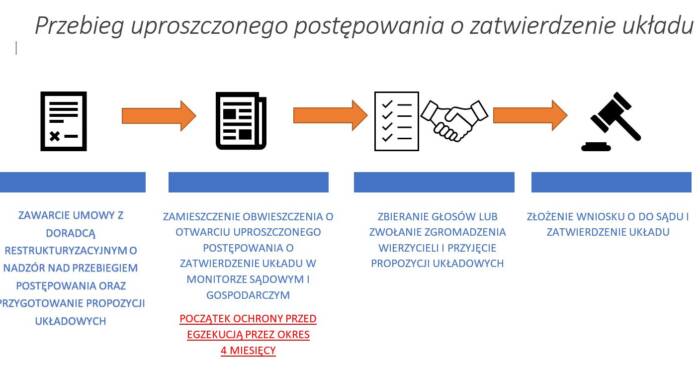
In response to the effects of the epidemic and in order to create another tool to help entrepreneurs, the legislator has introduced a new simplified restructuring procedure based on the existing arrangement approval procedure.
5 min.
19 July 2020
What are the consequences of failing to file for bankruptcy on time? Liability of management board members
The management board of a company that is unable to meet its liabilities cannot afford to remain inactive. The law clearly specifies when a bankruptcy petition must be filed – and what the consequences are for failing to comply with this obligation.
6 min.
10 May 2025


Amendment to the restructuring law – what will change in 2025?
On 23 August 2025, an amendment to the restructuring law came into force, implementing the so-called ‘Second Chance Directive’. The new regulations are intended to harmonise the rules for restructuring companies across the European Union and increase the effectiveness of bankruptcy prevention proceedings.
8 min.
04 November 2025


Arrangement approval proceedings – how can an entrepreneur quickly regain control over their finances?
The arrangement approval procedure is one of the most important restructuring tools, allowing entrepreneurs in financial difficulties to conclude favourable arrangements with their creditors.
6 min.
12 January 2025


Reorganisation proceedings – what do you need to know to successfully restructure your company?
Reorganisation proceedings are one of the most effective restructuring tools, allowing entrepreneurs to protect themselves from creditors and implement corrective measures. Thanks to this, a company can avoid bankruptcy and gain time to implement a strategy to improve its financial situation. What does this process look like and how can you increase its chances of success?
4 min.
11 February 2025



Which industries undergo restructuring most frequently in Poland?
Restructuring is a much-needed step for companies facing financial difficulties and looking for ways to improve their situation. In Poland, 4,130 companies began restructuring proceedings in 2023, an increase of 87.7% compared to 2022.
5 min.
30 March 2025


Accelerated composition proceedings – a lifeline for companies in financial crisis?
For many entrepreneurs, a financial crisis is a critical moment that requires decisive action. Accelerated composition proceedings (PPU) are a tool that allows companies to quickly reach an agreement with creditors, giving them a chance to regain financial stability.
5 min.
21 January 2025



How to effectively prepare a company for restructuring?
Company restructuring sounds like a challenge that only affects those who find themselves in crisis. But the truth is that every organisation, regardless of its current situation, may one day face the need to take corrective action.
10 min.
29 November 2024