On 1 December 2021, an amendment came into force which, with certain changes, permanently implemented the solutions offered by the simplified restructuring procedure.


On 1 December 2021, an amendment came into force which, with certain changes, permanently implemented the solutions offered by the simplified restructuring procedure.
This was the legislator’s response to the positive reception of the simplified restructuring proceedings developed during the pandemic. Under this amendment, the so-called Simplified Restructuring Proceedings became a permanent solution under the name of Proceedings for Approval of an Arrangement.
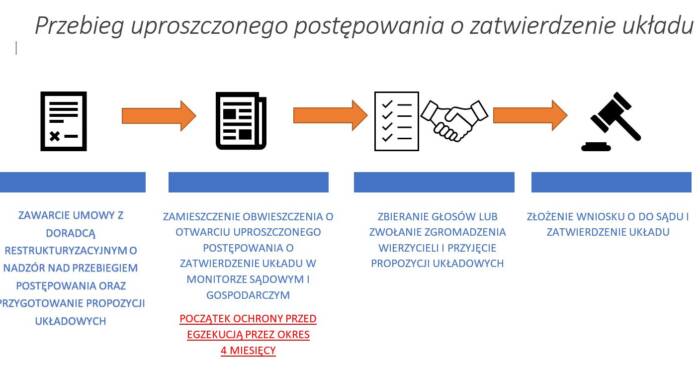
The most important features and effects of these proceedings include:
- Opening by an ICT system: National Debt Register.
- The need to draw up a list of claims, a list of disputed claims and a preliminary restructuring plan as a positive prerequisite for making an announcement on the setting of the arrangement date, i.e. the opening of proceedings.
- Suspension of enforcement by operation of law for a period of 4 months.
- Prohibition on initiating new enforcement proceedings, executing decisions on granting security, and ordering security for claims.
- Inclusion of claims (including those secured by mortgage) in the arrangement without the need for the creditor’s consent.
- Appeal procedure in the event of refusal to make an announcement by the restructuring adviser due to the existence of negative circumstances in his opinion.
- Maintenance of ordinary management of the enterprise.
- Preferential rules for calculating the majority required to adopt the arrangement. This means that the inactivity of the creditor will not block the conclusion of the arrangement.
- Easier opening of rehabilitation or bankruptcy proceedings in the event of non-approval of the arrangement.
- Protection against termination of contracts important for the enterprise.
- A significant disadvantage is the lack of exclusion of subsidiary liability of managers of capital companies for the company’s debts as a result of timely notification of the opening of proceedings for approval of the arrangement.
The proceedings also provide for the protection of creditors’ rights through, among other things:
- The debtor’s liability for damages.
- Limited duration of the proceedings.
- Revocation of the effects of the announcement of the arrangement date.
- Limit on the possibility of opening proceedings for the approval of an arrangement.
- Protection against the risk of the debtor circumventing the provisions on ineffectiveness.
We also invite you to read articles on this topic on the ministry’s website:
Related entries
Amendment to the restructuring law – what will change in 2025?
On 23 August 2025, an amendment to the restructuring law came into force, implementing the so-called ‘Second Chance Directive’. The new regulations are intended to harmonise the rules for restructuring companies across the European Union and increase the effectiveness of bankruptcy prevention proceedings.
8 min.
04 November 2025


Bankruptcies and Restructuring – summary of the first quarter of 2020.
Data on insolvency and restructuring from the first quarter of 2020 compared to the same period last year show a stabilisation in the number of restructuring proceedings and a slight increase in the number of insolvency proceedings, both among companies and consumers.
2 min.
22 April 2020


What are the consequences of failing to file for bankruptcy on time? Liability of management board members
The management board of a company that is unable to meet its liabilities cannot afford to remain inactive. The law clearly specifies when a bankruptcy petition must be filed – and what the consequences are for failing to comply with this obligation.
6 min.
10 May 2025


Restructuring adviser – what exactly are their powers?
Restructuring is one of the most important legal tools that the legislator has provided for entrepreneurs in financial difficulties. For this process to be effective, it is necessary to engage a specialist with the appropriate qualifications, experience and statutory powers – a restructuring adviser.
7 min.
23 April 2025


Which industries undergo restructuring most frequently in Poland?
Restructuring is a much-needed step for companies facing financial difficulties and looking for ways to improve their situation. In Poland, 4,130 companies began restructuring proceedings in 2023, an increase of 87.7% compared to 2022.
5 min.
30 March 2025
Reorganisation proceedings – what do you need to know to successfully restructure your company?
Reorganisation proceedings are one of the most effective restructuring tools, allowing entrepreneurs to protect themselves from creditors and implement corrective measures. Thanks to this, a company can avoid bankruptcy and gain time to implement a strategy to improve its financial situation. What does this process look like and how can you increase its chances of success?
4 min.
11 February 2025



Arrangement approval proceedings – how can an entrepreneur quickly regain control over their finances?
The arrangement approval procedure is one of the most important restructuring tools, allowing entrepreneurs in financial difficulties to conclude favourable arrangements with their creditors.
6 min.
12 January 2025


Suspension of enforcement without court proceedings, i.e. ‘Anti-Crisis Shield 4.0’ and new simplified proceedings for approval of an arrangement
In response to the effects of the epidemic and in order to create another tool to help entrepreneurs, the legislator has introduced a new simplified restructuring procedure based on the existing arrangement approval procedure.
5 min.
19 July 2020