Declaring consumer bankruptcy is one of the most common forms of legal debt relief in situations of permanent insolvency of a natural person. This procedure has been designed for debtors who do not run a business and are unable to settle their liabilities on time.


Declaring consumer bankruptcy is one of the most common forms of legal debt relief in situations of permanent insolvency of a natural person. This procedure has been designed for debtors who do not run a business and are unable to settle their liabilities on time.
Although the process itself may seem accessible and relatively simple, it requires precise preparation of the application and complete, transparent and accurate documentation. It is the quality of the materials collected that is of key importance for the court’s assessment of whether the conditions for declaring bankruptcy have actually been met. Errors at this stage not only prolong the proceedings, but may also lead to the application being dismissed on formal grounds.
Legal basis and grounds for declaring consumer bankruptcy
The institution of consumer bankruptcy is regulated by the Act of 28 February 2003 – Bankruptcy Law (Journal of Laws of 2022, item 1520, as amended), in Title V, Part III. The prerequisite for declaring consumer bankruptcy is the debtor’s insolvency, which means a state in which they are unable to meet their due financial obligations, with a delay in payment exceeding three months.
When considering the application, the court analyses not only the existence of insolvency in a purely economic sense, but also its nature and causes. Among other things, documents showing the history of debt, payment capacity, changes in income level and random events affecting the financial situation are verified. Currently, following the 2020 amendment, the court does not dismiss the application solely on the grounds that the debtor caused the insolvency intentionally or as a result of gross negligence, but these circumstances do affect the content of the final decision, in particular the length of the repayment plan. The application for bankruptcy is submitted to the district court – commercial division for bankruptcy matters, competent for the debtor’s place of residence.
Documents required when filing for consumer bankruptcy
An application for consumer bankruptcy must be submitted on an official form, which is widely available on the website of the Ministry of Justice. This form includes, among other things, the debtor’s personal details, information on the reasons for insolvency, a list of assets and liabilities, and monthly living expenses.
The application must be accompanied by a statement of income and expenses. In addition, it is necessary to submit documents confirming the current financial situation, including loan agreements, income certificates, enforcement documents and correspondence with creditors and public institutions.
When assessing the application, the court considers not only its formal correctness, but also the credibility and consistency of the data presented. In practice, the more detailed and complete the documentation, the more efficient the examination of the case and the greater the chances of a positive outcome.
List of creditors and detailed information about the debt
An integral part of the form is the list of creditors. The debtor is required to indicate all creditors known to them, together with full identification details – name or first and last name, address, as well as legal title and the exact amount of the debt. In addition, the due date of the liability must be indicated, which allows the court to assess whether the debt actually qualifies as ‘due’.
Both liabilities arising from credit agreements or loans, as well as rent arrears, maintenance arrears, debts to public authorities, court fees, administrative penalties and any other financial liabilities are subject to disclosure. Contingent liabilities must also be included. According to the case law of bankruptcy courts, failure to disclose all liabilities may be treated as an act of bad faith, which at a later stage of the proceedings may result in the refusal to write off debts or the revocation of the established repayment plan.
Documentation concerning assets and their components
The form also requires a detailed description of the assets. This applies not only to real estate and vehicles, but also to home furnishings, computer equipment, jewellery, cash assets, as well as shares in companies, property rights, savings and deposits. The value of each asset should be indicated, preferably based on current market data or expert appraisals.
Disclosure of all assets is important from the point of view of both the interests of creditors and the integrity of the proceedings. In the event of bankruptcy, these assets will be included in the bankruptcy estate and liquidated by the trustee. Concealing assets, donating them or selling them at an undervalued price shortly before filing the petition may be considered an action intended to harm creditors and result in negative legal consequences.
How to prepare the documentation correctly to avoid mistakes?
From the point of view of law firms and bankruptcy courts, the biggest problem is inaccurate, incomplete or contradictory information in applications. It is not uncommon for a single creditor to be indicated on the form, while the attached documentation shows that there are several. A lack of signature on the financial statement, incorrect calculation of monthly costs or outdated address details are just some of the typical errors.
Each of these errors requires a request for additional information, which prolongs the proceedings and sometimes even prevents them from being initiated. To avoid this, it is important to ensure that the data in all attachments is consistent, that the documents are in logical order, and that the information provided is up to date. It is definitely worth seeking the assistance of a restructuring advisor or legal advisor in this regard, who will not only verify the correctness of the documentation, but also help to prepare it in a manner that meets the requirements of court practice.
What happens after the application is submitted?
After the application is submitted, the court verifies its completeness and compliance with formal requirements. If there are any deficiencies, the debtor is requested to remedy them within seven days. If the documentation is correct, the court proceeds to examine the merits of the case. The grounds for insolvency, the accuracy of the statements made, and the circumstances surrounding the debt are analysed.
As a result, the court may declare bankruptcy, dismiss the application or discontinue the proceedings if there are negative grounds for doing so (e.g. lack of insolvency, obvious falsity of data). In the event of bankruptcy, the debtor’s assets are transferred to the administrator, who draws up an inventory and a liquidation plan. At a later stage, the court issues a decision on the repayment plan for creditors, the cancellation of part of the liabilities or, in special situations, complete debt relief without a repayment plan.
If you have any questions about consumer bankruptcy, please contact RBBC Law Firm. Our experts will be happy to help and advise you on the best solution.
Related entries
Panel on insolvency at the largest conference of the International Bar Association (IBA)
From 2 to 27 November, the annual conference of the largest international bar association, IBA 2020 VIRTUALLY TOGETHER, is taking place.
1 min.
07 November 2020



Can ‘Frankowicze’ obtain a suspension of instalment payments?
During the Covid-19 epidemic in Europe, the Swiss franc exchange rate rose significantly. For people who took out a loan denominated or indexed in Swiss francs, this means an increase in the outstanding loan principal.
4 min.
17 July 2020



Consumer bankruptcy – what exactly is it? What is worth knowing?
Financial problems can happen to anyone and are often the result of unfortunate random events such as job loss or serious illness. In such situations, feelings of overwhelm become commonplace, and getting out of debt may seem unattainable. One of the solutions offered by the Polish legal system is consumer bankruptcy.
6 min.
11 October 2024



Limited partnerships as corporate income tax payers – is this the end of limited partnerships in Poland?
This article will address the recently highly publicised issue of income tax on limited partnerships in Poland. On 28 October 2020, the Sejm passed an act amending the Corporate Income Tax Act and certain other acts (Sejm document no. 643), and the Senate will soon begin work on the adopted draft.
12 min.
01 November 2020



Webinar and Networking: Business Opportunities in Canada and the Visegrad Group “InnoV4te with Central and Eastern Europe”
Webinar and Networking: Business Opportunities in Canada and the Visegrad Group “InnoV4te with Central and Eastern Europe”
1 min.
26 April 2021



Membership in the International Bar Association (IBA)
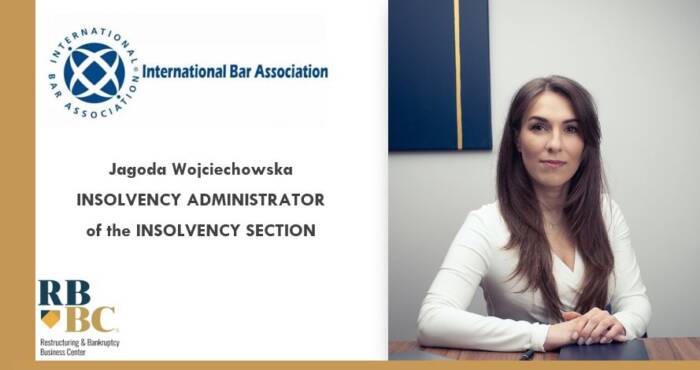
We are pleased to announce that Jagoda Wojciechowska, President of the Management Board, has been appointed Insolvency Administrator of the Insolvency Section of the International Bar Association (IBA), the largest international association of lawyers.
1 min.
20 April 2021

Reporting of tax schemes by 30 June 2020 at the latest?
On 1 January 2019, an amendment to the Tax Ordinance came into force. Taxpayers were imposed with a number of new obligations. First of all, a chapter on the submission of information on tax schemes was introduced.
1 min.
15 May 2020



The impact of the Covid-19 pandemic on changes in transfer pricing tax documentation obligations
Entities required to prepare transfer pricing documentation, both under the Personal Income Tax Act and the Corporate Income Tax Act, are required to submit transfer pricing information to the Head of the National Revenue Administration for the previous tax year.
3 min.
25 April 2020