
The arrangement approval procedure is one of the most important restructuring tools, allowing entrepreneurs in financial difficulties to conclude favourable arrangements with their creditors.


Arrangement approval proceedings – how can an entrepreneur quickly regain control over their finances?
6 min.
12 January 2025
Arrangement approval proceedings – how can an entrepreneur quickly regain control over their finances?
6 min.
12 January 2025
The arrangement approval procedure is one of the most important restructuring tools, allowing entrepreneurs in financial difficulties to conclude favourable arrangements with their creditors.
This procedure makes it possible to maintain current operations and avoid more radical forms of restructuring. Below is a detailed description of this form of restructuring, its application and practical guidelines.
What is the arrangement approval procedure?
The possibility of quickly agreeing on the terms of repayment of liabilities with creditors without having to go through full court proceedings is an important element of this procedure. Agreeing on the terms of the arrangement before referring the case to court allows you to avoid lengthy procedures and significantly reduce restructuring costs. Once the arrangement has been approved by the court, it becomes binding on all creditors covered by the proceedings, enabling the entrepreneur to effectively implement the recovery plan. Thanks to the flexibility of the procedure, the terms of the arrangement can be adapted to the specific financial situation of the entrepreneur.
Steps in the arrangement approval process
The process consists of several stages, which should be carried out meticulously and in accordance with the applicable regulations:
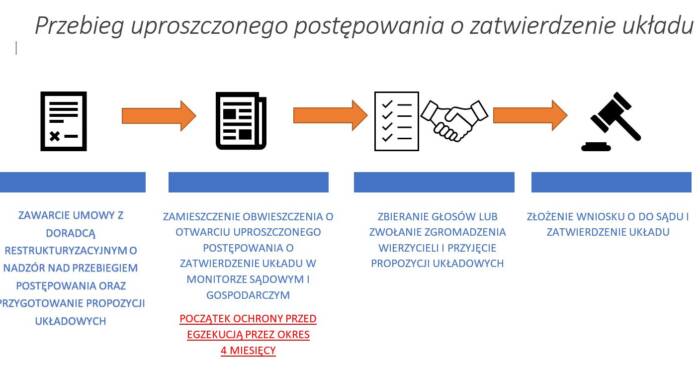
- Assessment of the company’s financial situation: the first step is a detailed analysis of the company’s financial condition. This includes identifying the amount of liabilities, analysing the debt structure and estimating the company’s real financial possibilities for the future.
- Development of arrangement proposals: at this stage, specific proposals are prepared for creditors, such as debt reduction, extension of repayment terms or even conversion of part of the debt into shares in the company. These proposals must be realistic and tailored to the company’s financial capabilities.
- Negotiations with creditors: an important element of the procedure is discussions with creditors, during which the aim is to obtain their acceptance of the proposed terms of the arrangement. It is important to obtain the consent of the majority of creditors representing a certain portion of the debt.
- Submitting an application to the court: after agreeing the terms of the arrangement with creditors, the entrepreneur submits an application for approval of the arrangement to the court. The application should be carefully prepared to avoid rejection at the formal stage.
- Implementation of the arrangement: once the arrangement has been approved by the court, the entrepreneur is obliged to implement it meticulously. This includes monitoring the repayment of liabilities in accordance with the schedule and responding to any unforeseen difficulties.
Each of these stages requires diligence and full commitment on the part of the entrepreneur. Correct implementation of the process increases the chance of successful implementation of the restructuring plan and stabilisation of the company’s financial situation.
Benefits of choosing this restructuring procedure
Concluding an arrangement with creditors as part of the arrangement approval procedure has many benefits for entrepreneurs in financial difficulty. First of all, it allows them to significantly reduce restructuring costs and avoid lengthy, complicated procedures such as reorganisation proceedings. The flexibility of this procedure allows the terms of the arrangement to be tailored to the specific nature of the company, which is of great importance in a changing market environment. What is more, maintaining the continuity of the company’s operations allows it to avoid negative consequences, such as the loss of key contractors or damage to its brand image.
However, the most important element of success is effective cooperation with creditors. Transparent and open communication with them allows for building trust, which significantly increases the chances of accepting settlement proposals. Creditors often expect detailed explanations of the company’s financial situation and clear plans for debt repayment. Negotiations can be challenging, so it is worth seeking the help of experienced restructuring advisors who not only support entrepreneurs at every stage of the talks, but also help to develop solutions that are beneficial to both parties.
Arrangement approval proceedings and other forms of restructuring
Compared to other restructuring procedures, such as accelerated arrangement proceedings or rehabilitation proceedings, arrangement approval proceedings are distinguished by their simplicity and speed of implementation. This makes them particularly attractive to companies that need immediate action to improve their financial situation.
Unlike more complex procedures, such as rehabilitation, arrangement approval proceedings allow entrepreneurs to retain greater control over their business and focus on its recovery. This form of restructuring is particularly recommended in situations where it is necessary to quickly regain financial liquidity without involving the court in lengthy proceedings. Importantly, arrangement approval proceedings allow for more flexible negotiations with creditors, which increases the chances of reaching an agreement that is beneficial to both the entrepreneur and their creditors.
Compared to other forms of restructuring, this procedure is significantly less burdensome for the company in terms of costs and formalities. This allows the entrepreneur to focus on rebuilding their market position and implementing a long-term development strategy.
How does RBBC support entrepreneurs in the restructuring process?
RBBC specialises in providing comprehensive support to entrepreneurs in restructuring processes, including proceedings for the approval of an arrangement. Our services include:
- Financial analysis: we help entrepreneurs understand their current financial situation and identify areas for improvement.
- Development of arrangement proposals: we assist in the preparation of detailed and realistic arrangement proposals that comply with the law and are likely to be accepted by creditors.
- Negotiations with creditors: we conduct talks on behalf of our clients, providing professional support and striving to achieve favourable terms of the arrangement.
- Preparation of documentation and representation in court: we ensure that the application for approval of the arrangement is correctly prepared and represent entrepreneurs in court at every stage of the proceedings.
- Monitoring the implementation of the arrangement: once the arrangement has been approved, we provide support for its implementation, monitoring compliance with the schedule and advising in the event of difficulties.
Thanks to our experience in the field of restructuring, entrepreneurs can count on effective and professional support.
An effective solution for entrepreneurs
Arrangement approval proceedings give entrepreneurs a real chance to regain control of their finances and avoid bankruptcy. With RBBC’s support, you can count on a professional and comprehensive approach at every stage of the process. Don’t wait for your financial problems to get worse – contact us today to discuss possible solutions and restore stability to your business.
Related entries
Changes to restructuring law in 2025
On 25 July 2025, the Sejm of the Republic of Poland passed an act amending the Restructuring Law, the Bankruptcy Law and the National Debt Register Act. On 5 August this year, the amendment was signed by the President of the Republic of Poland and will become binding law 14 days after its publication in the Journal of Laws.
1 min.
05 August 2025
What are the consequences of failing to file for bankruptcy on time? Liability of management board members
The management board of a company that is unable to meet its liabilities cannot afford to remain inactive. The law clearly specifies when a bankruptcy petition must be filed – and what the consequences are for failing to comply with this obligation.
6 min.
10 May 2025


Last opportunity for restructuring under the old regulations!
The amendment to the Restructuring Law, signed by the President of the Republic of Poland on 5 August 2025, will enter into force 14 days after its publication in the Journal of Laws. Therefore, we are approaching the end of the transition period during which it is possible to initiate restructuring proceedings under the existing rules.
1 min.
08 October 2025


How to effectively prepare a company for restructuring?
Company restructuring sounds like a challenge that only affects those who find themselves in crisis. But the truth is that every organisation, regardless of its current situation, may one day face the need to take corrective action.
10 min.
29 November 2024



Arrangement proceedings – how to reach an agreement with creditors and save your company?
Increasing debt, liquidity problems and mounting creditor claims can threaten the functioning of even prosperous companies. Many entrepreneurs in such a situation face a dilemma: is bankruptcy the only solution?
5 min.
05 February 2025


Amendment to the restructuring law – what will change in 2025?
On 23 August 2025, an amendment to the restructuring law came into force, implementing the so-called ‘Second Chance Directive’. The new regulations are intended to harmonise the rules for restructuring companies across the European Union and increase the effectiveness of bankruptcy prevention proceedings.
8 min.
04 November 2025


Suspension of enforcement without court proceedings, i.e. ‘Anti-Crisis Shield 4.0’ and new simplified proceedings for approval of an arrangement
In response to the effects of the epidemic and in order to create another tool to help entrepreneurs, the legislator has introduced a new simplified restructuring procedure based on the existing arrangement approval procedure.
5 min.
19 July 2020
Bankruptcies and Restructuring – summary of the first quarter of 2020.
Data on insolvency and restructuring from the first quarter of 2020 compared to the same period last year show a stabilisation in the number of restructuring proceedings and a slight increase in the number of insolvency proceedings, both among companies and consumers.
2 min.
22 April 2020


