
In response to the effects of the epidemic and in order to create another tool to help entrepreneurs, the legislator has introduced a new simplified restructuring procedure based on the existing arrangement approval procedure.
Suspension of enforcement without court proceedings, i.e. ‘Anti-Crisis Shield 4.0’ and new simplified proceedings for approval of an arrangement
5 min.
19 July 2020
Suspension of enforcement without court proceedings, i.e. ‘Anti-Crisis Shield 4.0’ and new simplified proceedings for approval of an arrangement
5 min.
19 July 2020
In response to the effects of the epidemic and in order to create another tool to help entrepreneurs, the legislator has introduced a new simplified restructuring procedure based on the existing arrangement approval procedure.
This solution was adopted by the Act of 19 June 2020 on subsidies for interest on bank loans granted to entrepreneurs affected by COVID-19 and on simplified proceedings for the approval of arrangements in connection with COVID-19, the so-called Anti-Crisis Shield 4.0 (hereinafter: ‘Shield 4.0’), which came into force on 24 June this year. Importantly, each entrepreneur may only use the simplified procedure for approval of an arrangement once, and it will be available only for the next year, i.e. until 30 June 2021 (Article 15 of Shield 4.0).
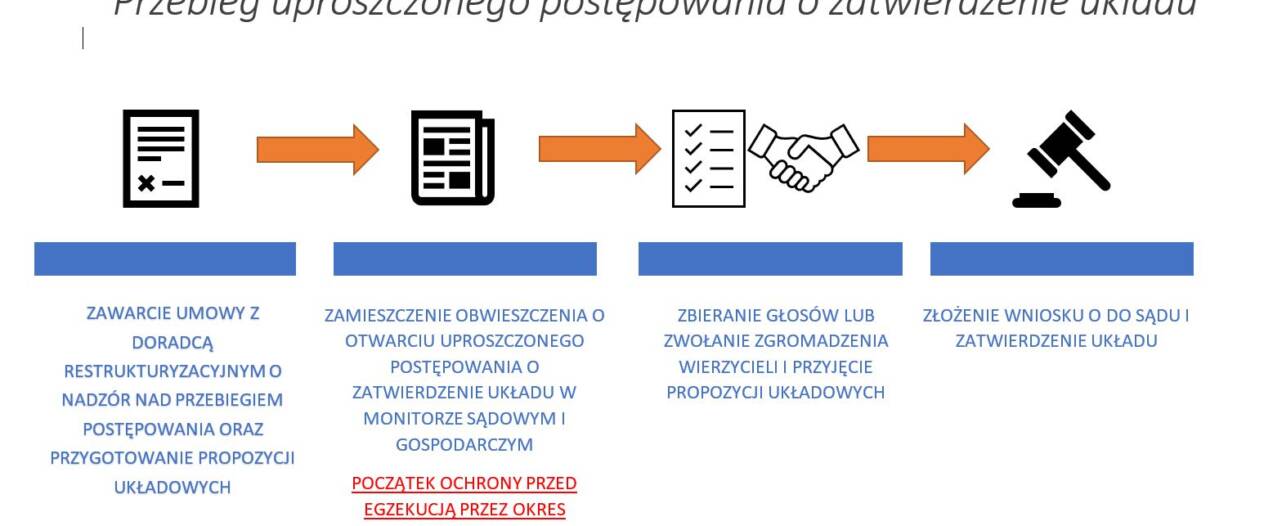
In order to initiate the proceedings, an agreement must be concluded with a restructuring adviser to supervise the proceedings. The proceedings are opened out of court, on the date of publication of an announcement in Monitor Sądowy i Gospodarczy (Court and Economic Monitor), in which the entrepreneur declares that they have concluded an agreement with a restructuring adviser and that simplified proceedings for the approval of an arrangement will be conducted in relation to them.
The most important effect of the publication of the announcement from the entrepreneur’s perspective is the suspension of pending enforcement proceedings and the inability to initiate new enforcement proceedings against the debtor’s assets.
In practice, this means that the legislator has significantly facilitated and, in fact, introduced enforcement protection to out-of-court proceedings for the approval of an arrangement. Using the new simplified proceedings for the approval of an arrangement from the date of publication of the announcement of the opening of proceedings in the Court and Economic Monitor until the date of discontinuation or termination of the proceedings for the approval of the arrangement:
- enforcement proceedings concerning claims covered by the arrangement by operation of law and concerning claims secured by the debtor’s assets (mortgage, pledge, etc.), in which the arrangement proposals provide for the satisfaction of the secured creditor together with incidental claims, initiated before the date of opening of the proceedings, are suspended by operation of law;
- it is not possible to initiate new enforcement proceedings – the initiation of enforcement proceedings and the enforcement of a decision to secure a claim or an order to secure a claim arising from a claim covered by the arrangement by operation of law and a claim secured by collateral, which the arrangement proposals provide for satisfaction together with incidental claims, is inadmissible;
- the provisions of Article 252 (inadmissibility of payments from claims covered by the arrangement), Article 253 (inadmissibility of mutual set-offs) and Article 256 (inadmissibility of termination of lease or tenancy) of the Act of 15 May 2015 – Restructuring Law shall apply accordingly; the permits referred to in Article 256(1) of the Act of 15 May 2015 – Restructuring Law shall be issued by the arrangement supervisor.
This procedure, and thus enforcement protection, should last four months from the date of publication of the announcement in Monitor Sądowy i Gospodarczy (Court and Economic Monitor). During this time, a creditors’ meeting should be held and, in the optimal scenario for all parties, an arrangement should be concluded. Another simplification is the possibility of voting at the creditors’ meeting using electronic means of communication. The minutes of such a creditors’ meeting in the form of, for example, a videoconference must contain a record of the meeting on an electronic data carrier. This is therefore a very significant technical, organisational and even economic simplification. Creditors do not bear the costs of travelling to the creditors’ meeting.
The supervisor confirms the acceptance of the arrangement and prepares a motion to the restructuring court for approval of the accepted arrangement. If, within 4 months of the date of the announcement, no motion for approval of the arrangement is filed with the court, the proceedings are discontinued by operation of law. It should be emphasised that if no arrangement is concluded, the debtor still has the right to use other restructuring proceedings. Moreover, if an arrangement is concluded and the proceedings are discontinued after the submission of a request for approval of the arrangement, the debtor has the option of submitting a simplified request for the opening of rehabilitation proceedings or a simplified request for the declaration of bankruptcy.
In addition, the legislator has provided financial security for the entrepreneur by setting limits on the remuneration of the restructuring adviser in the event of a final refusal to approve the arrangement or discontinuation of the proceedings. The remuneration of the arrangement supervisor provided for in the agreement may not exceed twice the average monthly remuneration in the enterprise sector without profit-sharing payments in the third quarter of the previous year, as announced by the President of the Central Statistical Office.
In conclusion, the most advantageous solutions of the proposed simplified arrangement approval procedure include:
- suspension of existing enforcement proceedings without the involvement of the court, only after concluding an agreement with a restructuring adviser and publishing a notice in the MSiG;
- no possibility of initiating new enforcement proceedings;
- speed of opening proceedings (a few days);
- possibility of holding a creditors’ meeting using electronic means of communication;
- low costs of proceedings.
Related entries
Amendment to the restructuring law – what will change in 2025?
On 23 August 2025, an amendment to the restructuring law came into force, implementing the so-called ‘Second Chance Directive’. The new regulations are intended to harmonise the rules for restructuring companies across the European Union and increase the effectiveness of bankruptcy prevention proceedings.
8 min.
04 November 2025


Accelerated composition proceedings – a lifeline for companies in financial crisis?
For many entrepreneurs, a financial crisis is a critical moment that requires decisive action. Accelerated composition proceedings (PPU) are a tool that allows companies to quickly reach an agreement with creditors, giving them a chance to regain financial stability.
5 min.
21 January 2025



Changes to restructuring law in 2025
On 25 July 2025, the Sejm of the Republic of Poland passed an act amending the Restructuring Law, the Bankruptcy Law and the National Debt Register Act. On 5 August this year, the amendment was signed by the President of the Republic of Poland and will become binding law 14 days after its publication in the Journal of Laws.
1 min.
05 August 2025
How to effectively prepare a company for restructuring?
Company restructuring sounds like a challenge that only affects those who find themselves in crisis. But the truth is that every organisation, regardless of its current situation, may one day face the need to take corrective action.
10 min.
29 November 2024



What about COVID-related restructuring?
On 1 December 2021, an amendment came into force which, with certain changes, permanently implemented the solutions offered by the simplified restructuring procedure.
2 min.
03 February 2022


What are the consequences of failing to file for bankruptcy on time? Liability of management board members
The management board of a company that is unable to meet its liabilities cannot afford to remain inactive. The law clearly specifies when a bankruptcy petition must be filed – and what the consequences are for failing to comply with this obligation.
6 min.
10 May 2025


How does company restructuring protect against bankruptcy?
When a company faces financial difficulties, restructuring is often the last chance to avoid bankruptcy. Companies that identify financial problems early on can implement corrective measures, protecting themselves from complete operational and legal collapse.
7 min.
13 October 2024


Which industries undergo restructuring most frequently in Poland?
Restructuring is a much-needed step for companies facing financial difficulties and looking for ways to improve their situation. In Poland, 4,130 companies began restructuring proceedings in 2023, an increase of 87.7% compared to 2022.
5 min.
30 March 2025


